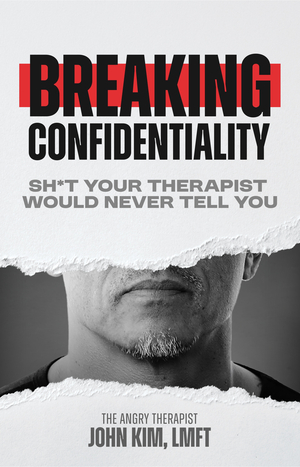
A licensed therapist says the quiet part out loud. Read it before his colleagues do.
Have you ever wondered what your therapist really thinks of you?
Have you ever been curious what your therapist is like outside of your sessions?
Have you ever considered that the person you share your most private struggles with has demons of their own?
John Kim was fresh off a divorce when he decided to become a therapist. What started out as a dream of stability—an office with a mini Zen garden, button-down shirt and Dockers, guidance given out in tidy 50-minute time slots—quickly transformed into an entirely new way of helping people. He traded the office for a coffee shop, a tucked-in shirt for tattoos and a motorcycle, and professional distance for casual relationships based on shared humanity.
The result was a mixture of profound breakthroughs and blurred boundaries. Therapy school had prepared John for unmotivated clients, treatment-resistant diagnoses, and logging detailed case notes after each session. But he was never taught to navigate the messy stuff: liking one person in couple's therapy more than the other, having a client form an attachment bordering on stalker behavior, or trying to hold space for someone's problems when you haven't even come close to figuring out your own.
In Breaking Confidentiality, John gives an honest account of what most other therapists are too scared to reveal—or would lose their licenses if they admitted. Each chapter exposes a different example of what goes on behind closed doors—attraction, bias, jealousy and yes, boredom—offering a fascinating glimpse into what happens when two nervous systems come together, stumbling their way through processing emotions, past traumas, triggers, and heartbreak. It dissects the most intimate and misunderstood relationship of our time, the therapist and client, and ultimately proves that what people need most is not someone to fix their problems—it's someone to sit beside them, present, imperfect, and human.