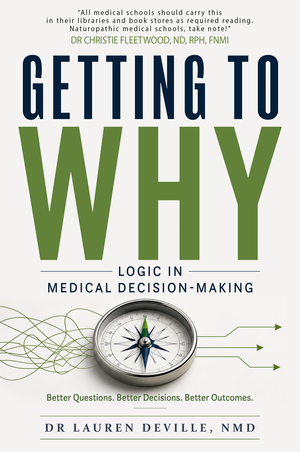
Finding the root cause and building a personalized treatment plan, regardless of the diagnosis.
Practitioners treating chronic disease share a problem that cuts across every discipline: they have more diagnostic tools than ever, but no shared logic for sequencing intervention. A naturopathic physician, a functional medicine MD, and an integrative NP looking at the same patient will often reach for different treatments first—not because they disagree on the underlying science, but because none of their training gave them a decision hierarchy for when to intervene, only lists of what to consider.
Getting to Why: Logic in Medical Decision-Making first challenges the reader to reconsider common medical assumptions that rest upon fallacious reasoning. From there, it gives practitioners of all specialties a decision framework for chronic disease that doesn't depend on already knowing the diagnosis. It assumes the reader already has a working knowledge of physiology and pathophysiology, and provides a heuristic for finding root cause and building a personalized treatment plan from there—rather than defaulting to standard-of-care algorithms.
Getting to Why is a clinical reasoning text built around the therapeutic order—an eight-level framework that sequences care from root-cause identification and removal through palliation. The therapeutic order reframes the clinical question from "what should I do for this diagnosis" to "what does this patient's physiology need first, and why"—treating the body as a self-regulating system to be supported in sequence, not a set of symptoms to be matched against a list of interventions.