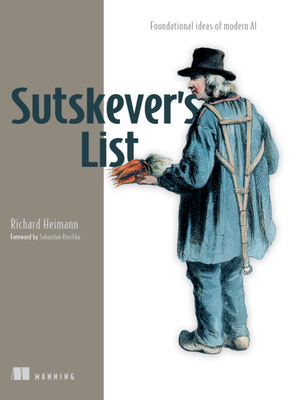
Sutskever’s List is a guided intellectual journey through the ideas that made modern AI suddenly possible. Each chapter is anchored in specific papers, books, or other sources from Sutskever’s list. The papers themselves are not the focus. Instead, the author uses them as entry points into the larger breakthroughs, arguments, interconnections, and shifts in thinking that transformed the field.
It begins with AlexNet, where data, GPUs, and training craft made neural networks impossible to dismiss, then moves to ResNet, where depth becomes a superpower rather than a liability. From there, the story accelerates through sequence models, speech systems, attention, Transformers, and hyperscale, showing how AI escaped older bottlenecks and became built to grow.
Later chapters ask whether these systems can reason, why simplicity can emerge from complexity, and what intelligence and safety mean once AI capabilities begin to feel uncanny. Reviewers praise Heimann’s “exquisitely deep, detailed, and nuanced knowledge” and the “massive amount of gold material” gathered here. Yet the book remains remarkably easy to read, turning difficult papers into a “guided initiation those papers were never designed to provide on their own.”
Each of the core papers examined in Sutskever’s List represents a crucial steppingstone in the evolution of the AI. You’ll love how Richard Heimann combines a deep technical background with a journalistic eye, never losing sight of practical considerations and providing a stepping off point to understand where the technology goes next.
Sutskever’s List features nine chapters, an epilogue, and a practical appendix, smoothly blending technical instruction with cultural and historical context. The result is a logically flowing book that remains highly accessible, navigable, and technically deep without requiring the reader to have a specialist’s background.
What's inside:
- Decoding landmark AI papers from AlexNet to transformers
- Understanding scaling laws, reasoning models, and AI safety
- Engineering patterns that scale from research to real-world systems