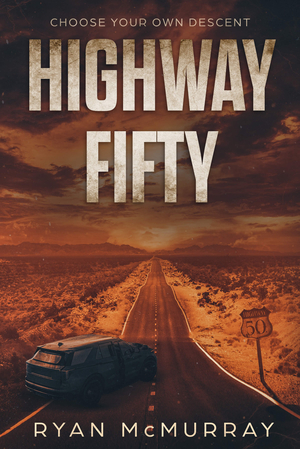
They call Highway Fifty the Bermuda Triangle of the West.
After the death of his father, Josh sets out across the American West with his best friends, Tim, Theo, and Patrick. What begins as an attempt to escape their grief slowly turns into something stranger along Nevada’s Highway 50, the Loneliest Road in America.
Shortly after losing sight of civilization, the road stops behaving normally.
Night never fully arrives. Distances begin to change. Hours vanish without explanation. And when one of Josh’s party disappears into the endless twilight surrounding their campsite, the group is forced deeper into the desert searching for both their friend and a way forward.
The farther Highway 50 is traveled, by both the group and the reader, the more the desert seems to reshape itself. Roads loop. Landmarks return. Choices carry consequences that refuse to stay buried.
Each path forward forces the group to confront the question they came west trying to outrun:
What if escape was never possible to begin with?
A note for readers: "Highway Fifty" is an experimental literary horror novel that uses unconventional narrative techniques throughout, including unattributed dialogue, shifting perspectives, interwoven short stories, multimedia elements, and branching narrative paths. Readers who enjoy formally experimental fiction such as "House of Leaves" and "Haunted" will likely feel most at home here.
While "Highway Fifty" offers a choose-your-own-path experience, its branching structure is less traditional choose-your-own-adventure and more an extension of the novel's themes, with substantially different narratives and perspectives unfolding depending on the reader's choices.
"Highway Fifty" is a surreal literary horror novel about grief, codependence, and the terrifying comfort of refusing to move on.