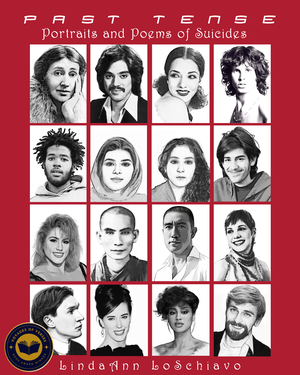
This illustrated poetry collection raises the dead—and lets them finally name what undid them.
In an award-winning chapbook "Past Tense: Portraits and Poems of Suicides," twenty-three lives—spanning 120 years, some world-famous and some known only to the few who loved them—are given voice through poems uniquely shaped to match their subjects. Virginia Woolf, Kate Spade, Aaron Swartz, Jim Morrison, and Diane Arbus appear alongside figures far less documented, each explored—not to explain their deaths but to sit inside the moment closest to the unknowable.
Each poem is written in a form chosen to match its subject—not decoration, but architecture. A cento built from Vachel Lindsay's own lines. An erasure that lets Virginia Woolf's farewell letter point toward a second, hidden meaning. A poem composed in computer code for a programmer. A dynamic range of forms—arrow-shot elixirs in words—explores the shock of suicide and reflects the elusive nature of mental illness, sometimes by borrowing confessions from the very lives the collection honors.
Most poems step inside the final moment itself, holding distance at bay, resisting summary. A handful do something else instead—they hold their subjects to account rather than mourning them, unwilling to let judgment stay silent. The collection does not ask readers to grieve uniformly. Some of these deaths were tragedies. Some were the last act of someone who had already caused irreparable harm to others. Past Tense holds both truths without flattening either one.
The book resists tidy categories on purpose. Some subjects took their own lives in despair; one, a Buddhist monk, in protest. Some left notes that are now part of the public record; others left almost nothing behind at all. The poems do not explain why. They inhabit the moment closest to the unknowable and let form do what argument cannot.
Written across a wide range of poetic structures—several rarely seen together in a single collection—Past Tense is as much a demonstration of what poetic form can hold as it is a meditation on memory, judgment, and the stories we tell after someone is gone.