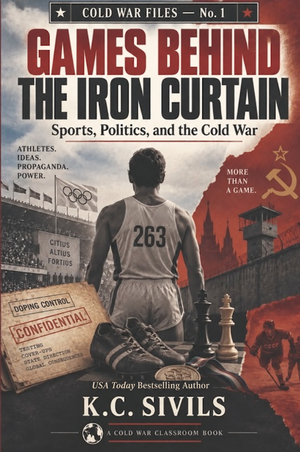
For decades, the United States and the Soviet bloc battled for influence around the world. They competed in military power, technology, space exploration, propaganda—and sports.
To communist governments, an Olympic medal represented far more than athletic achievement. Victory offered evidence that their system could produce stronger athletes, better teams, and a superior society. Governments invested enormous resources in finding, training, controlling, and sometimes chemically enhancing athletes who could win on the international stage.
Games Behind the Iron Curtain: Sports, Politics, and the Cold War explores what happened when international competition became an instrument of the state.
From the controversial final seconds of the 1972 Olympic basketball championship to East Germany's systematic doping program, the book examines some of the Cold War's most remarkable sports controversies. It follows athletes, coaches, officials, doctors, and intelligence services through a world in which winning and losing carried consequences far beyond the scoreboard.
Discover the stories behind Soviet and East German sports systems, Olympic doping, disputed medals, judging controversies, age falsification, surveillance of athletes, chess as political theater, and the Russian sample-swapping operation exposed after the Sochi Olympics.
You'll encounter Boris Onishchenko's altered épée, the disputed decision that denied American boxer Roy Jones Jr. Olympic gold, the extraordinary Karpov–Korchnoi chess confrontation, the tragedy surrounding East German footballer Lutz Eigendorf, and other episodes where sports, ideology, and state power collided.
But Games Behind the Iron Curtain is about more than scandals. It examines why communist governments placed such importance on athletic success, how centralized systems identified promising children and transformed them into elite competitors, and why international victories became valuable propaganda in the struggle with the West. It also considers the human cost when athletes became instruments of state policy.
Because behind the Iron Curtain, sometimes the most important part of the game had nothing to do with the game itself.