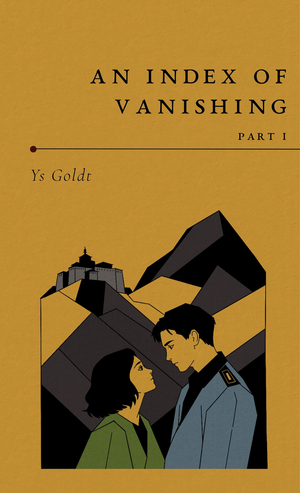
A slow-burn alternate-history romance told through the private journal of a young intelligence officer who falls for the asset he was sent to evaluate.
Matthias Krüger is twenty-five, recently posted, and very good at his job. His orders at the remote Himalayan monastery are simple: observe the Reich's most classified paranormal asset, report on her progress, and remain detached. The subject reads Dostoevsky between rifle shots, sings poetry on the high ridges at dawn, and can vanish into thin air. She looks at him like she has already made up her mind about something he hasn't.
He does not stand a chance.
They call her Leise. She has survived what should have unmade her, and she has not forgiven the world for it. Krüger watches her from archways and doorways and the careful middle distance. She lets him. One night, alone in his room, he plays his guitar for the first time in months, and in the morning she tells him it sounded sad, but nice.
After that, he cannot look at her without forgetting his orders.
He has spent his life behind a wall—built in a Berlin apartment in 1919, brick by brick, after influenza took both his parents in a single winter. She is the first person who has ever looked at him as if she could see straight through it, and worse, as if she might be willing to wait on the other side.
To want her is treason. To touch her is ruin. And he has not wanted anything in years.
Set in a 1938 where the Reich's paranormal ambitions are quietly, terribly real, An Index of Vanishing is a literary alternate-history romance about obsession, longing, and the cost of being seen—about a young man trained to watch, and the girl who watched him back.
Content notes: Adult themes including obsessive / intrusive desire, accidental voyeurism, suicidal ideation, depictions of grief and childhood loss, a POV character serving in the SD in pre-war 1938, sexual fantasy (no explicit on-page sex in part 1), slow burn, ends on an unresolved emotional cliffhanger as the first book in a series.