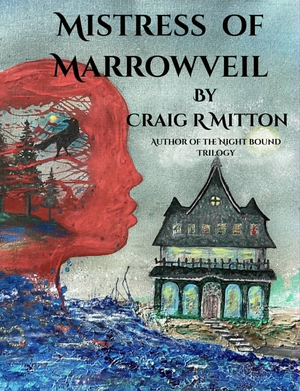
Over a hundred years is a long time to wait. She was worth it.
Aisling Brennan has built her career on a single principle: there is always an explanation. As a paranormal investigator and professional debunker, she has spent eleven years finding the mechanism behind every haunting—the faulty wiring, the acoustic anomaly, the grief-stricken mind constructing comfort from shadow and sound. She has never found a house she couldn't explain.
Perched on a Pacific cliff, Marrowveil Manor has been empty for decades. Its legends are numerous and colourful: unexplained disappearances, a Victorian family destroyed by scandal and tragedy, a wife who went into the sea on a stormy November night and was never recovered. Aisling arrives with her equipment and her scepticism and her carefully maintained professional distance, prepared to document and debunk and leave.
What she is not prepared for is Julian.
Julian Marrowveil has been dead for over a century. He is also, undeniably, present—a ghost with a voice like old money and a century of guilt he has never been able to put down. He has been waiting in Marrowveil's walls since 1912, and when Aisling arrives, he knows, with a certainty that unsettles them both, that she is the reason he has waited. She hears him in ways no one else ever has. She asks questions no one else has thought to ask. And she carries something in her that the house has been missing since the night his wife went over the terrace railing and into the sea below.
The Mistress of Marrowveil is a gothic romance for readers of Silvia Moreno-Garcia's Mexican Gothic and Jeaniene Frost's Night Huntress series—atmospheric, emotionally precise, and built on the conviction that the most haunted places are not houses but people, and that forgiveness, real forgiveness, is not something you arrive at. It is something you choose, again and again, in full knowledge of what it costs.